Open letter to Jude Kelly, Artistic Director of the Southbank Centre.

Dear Jude
I'm writing to you as a friend. True, I don't know you personally, but I've been aware of you and your work for as long as I can remember and from what I do know about you, I have no reason to doubt that your intentions are good.
Sadly, as everyone knows, good intentions still pave ill roads and I fear you're about to make the biggest mistake of your life. So you could say I'm writing to protect you from yourself. That may be presumptuous of me, and irk you greatly, but it's nevertheless true. Here's why:
In your video interview you say it is "important to explain what the dilemma is for the skateboarders," in relation to your planned development of the Southbank Centre with the Festival Wing.
But it is not the skateboarders who have a dilemma, it is you. The skateboarders and street artists made the undercroft at the South Bank their home forty years ago; it has grown, over four decades, to be the beating heart of urban culture in London.
The skateboarders know what they want, they want to stay, because the space is perfect for them, it has become 'theirs'. 'Theirs' not in a property ownership sense, the way an estate agent or investor might understand it, 'theirs' in a cultural sense, that a lot of us, people of London, can understand, and relate to: after all, they, the skateboarders and graffiti artists, share it with us, every day, every night, by letting us be part of the joy, the spirit and the art they create, for free, right there, as it happens.
(And as somebody who has never skated further than five yards, nor even really tried, I can honestly say: I am not a skater. Not even a wannabe skater. I am most definitely and defiantly a non-skater. Yet not once have I passed the undercroft without my heart skipping a little beat of happiness for the simple fact that it's there: the last free, uncommercial, unsponsored, unsullied spot in London.)
Now, you argue that the South Bank is for everyone. And that's precisely why this matters so much. You even go as far as saying: "we like the skateboarders being here, they're part of our family." And yet you want to shift them. You want to shoo them along, only a hundred yards, you say, into an 'even bigger, better' space, underneath the Hungerford Bridge.
This sounds so reasonable, almost kind, it feels petulant to argue with it. But 'reasonable' and 'kind' is not necessarily 'right'. Because here comes the crucial point: the undercroft as it is today is exactly what makes it so special. It's the truly unique feature of the South Bank. Let me explain why, starting with your argument:
You say you want to turn the Southbank Centre into "the next thing, to allow even more people to use it." And you cite particular uses you have in mind: you say the site "needs education centres for young people," a "children's centre" and "rehearsal rooms for musicians." And nobody would argue that these are not worthy projects. But they don't have to be in the undercroft, they can be anywhere, they're just spaces that can be defined in any other part of your 28 acre site, by any architect worth their fee.
You then go on to say that there are many things like this "that would make the site somewhere extraordinary for many more people," but in actual fact what you're proposing is to take away the most extraordinary thing that the South Bank has and use it to finance very ordinary - albeit worthy - projects that any arts centre in the world could, would and should have. You want to move the single one thing that has evolved over nearly two generations into a genuinely iconic space - not a marketing-speak, advertising copy 'iconic' thing that is really manufactured and sponsored and that yields a return on investment, but a real urban cultural phenomenon that has sprung up on its own terms in its own way in a place that is just right for it - and turn it into your cash cow for something else.
And there is no doubt that that is what you're proposing. You spell it out yourself: "we have to use that riverside front and turn it into a space where people can eat and drink, and that will generate the income to pay for all these other activities for everybody else."
And here lies the deep flaw in your thinking. You have bought into the thinking of the corporation, the thinking that seeks to expand at all cost, to maximise 'benefit', to control everything and make it 'better'.
But you don't have to do any of these things. These are all choices you make, because to you they seem so sensible, so reasonable. They will seem sensible, reasonable to anyone with a corporate mindset, because that's what power bases do: they expand and solidify, they control and absorb. They shore themselves up. Always 'for the benefit of the consumer', of course. You want to do with the Southbank Centre what any brand manager wants to do with their washing-up liquid or shampoo. Make it 'even better', with a 'new formula', that 'lasts even longer.'
So you're asking for what you're calling a compromise. And to illustrate how sensible and reasonable you're being, you compare the case of the undercroft to the case of the Festival Hall cloakroom. And this, I fear, is where you betray the fact that you don't understand at all what you're dealing with. The cloakroom of the Festival Hall is a utility. Like the rehearsal rooms you wish for, and the children's centre, the cloakroom is a bit of space that can be put anywhere that 'makes sense'. There is no intrinsic heart or value - dare I say soul - to it.
You think the undercroft is like that. You overlook the most important part of the story: the invaluable component. The thing that money just can't buy. Let me give you a better example than your cloakroom:
Think of the Fourth Plinth in Trafalgar Square. Anyone with a good business mind like yours could come and say: "This thing is quirky, fun, we love it, it's part of our square, but it also sits in a prime spot which we could utilise much better. So why don't we tear it down, build another empty plinth a few yards to the left, say behind Admiralty Arch, and there the artists with their creativity, which we love, can go and invent things in a facility that is much better for them. And instead of the empty plinth, we'll use that prime spot in Trafalgar Square to build a permanent bright LED screen where we can have film screenings for kids in the afternoon and for grown ups in the evenings, and we can have a shop to sell merchandise and a coffee stall to generate income to finance these fabulous activities that will benefit everyone. Isn't that reasonable? Doesn't everybody win?"
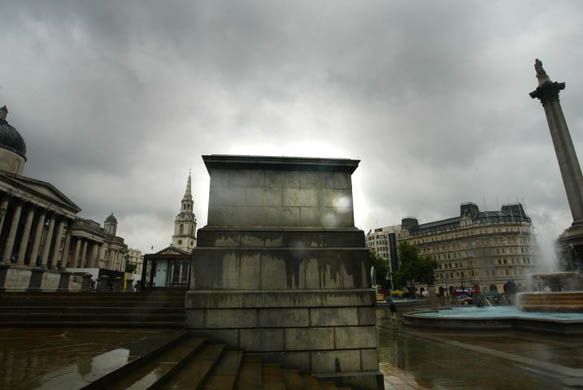
Well, think it through: there are big squares in every city in the world. So what makes Trafalgar Square what it really is? Yes, its location, its size; the lions, the fountains, Nelson's Column. But they could all be configured otherwise, and elsewhere. What makes it really what it is is the way every component plays together to form a whole, and how that whole is being used. By tourists, by protesters, by the people of London when they come together to celebrate or mourn: this is one sum that is infinitely greater than its parts. And one of the singularly most extraordinary elements in the mix is the Fourth Plinth. Its history, its shape, its location, they all make it genuinely, properly unique. Not concept-speak unique, the way that your PR advisor uses the term, but really, profoundly singular.
So of course, a bright mind with a great sense for business can come along and maximise the use of Trafalgar Square, 'make it better' for everyone. And countless must have been the temptations to do precisely that, to put the empty plinth to 'proper' use; a guided, a directed, a controlled use. And the moment you do that, you ruin the whole. The moment you do that you take away the thing that gives it the magic, the indescribableness, the actual good.
I've invoked The Beatles, to dubious effect, and now it's time for Oscar Wilde. You're an arts practitioner; you have a past in creating things that have a value beyond cash. I hardly need to hold up to you the truism about knowing the price of everything and the value of nothing?
If you appropriate the undercroft and turn it into a commercial space to finance your projects at the Southbank Centre, you'll probably succeed. Once the dust has settled, it will all be pleasant. People like you and I will be able to sit there and enjoy the view. Have a cappuccino or, if it's a lovely evening, a glass of prosecco. And our conscience can be clean because with our good taste and benign pursuit of simple pleasures we'll even be helping finance some workshops for the poor disadvantaged children of the area. How comfortable that is: the pleasing integration of the creative industries with consumerism, of commerce and art. How reasonable.
But can you see it by now: that's not the point. It's not your job to do this. You are not the owner of the South Bank and your Trust is not the owner either. You are the custodians of a place of unquantifiable value. Innumerable also must have been the temptations for someone like you to come along and straighten the Tower of Pisa. Maybe strengthen it a bit; build a turntable restaurant at the top; increase revenue and finance important projects. The urge for people in power to 'do something purposeful' with their power is built into the very nature of power. Of course you want to. And you probably can. But don't.
This is your opportunity to shine with true insight and power, by not using your position to 'make things better' but to leave things alone as they are, because they are perfect just the way they are. In their imperfection lies their value. In their cracks is the freedom that lets the light shine through (sorry, Bob). In their idiosyncrasy rests their power.
This is the moment you can show the world that you are someone who can distinguish between price and value, that you understand and connect with value. Real value. Where it can't be bought, designed, packaged and created on purpose by architects and planners and artistic directors. Where the art directs itself. Where the energy that people put into a place takes on a power of itself. Where your duty is one thing and one thing only: to recognise it, respect it and, yes, let it be.
Your Wikipedia entry describes you as one of the 100 most powerful women in the United Kingdom. Make this the monument to yourself, Jude Kelly: become forever known as the woman who knew when to desist, be the person in power who used her power to protect the heart at the heart of the matter from herself.
Be the woman whom generations will remember as the one who, when she was in charge of the South Bank, did not put a price on it, but cherished its value.

Here is a really excellent short film by Henry Edwards-Wood:
Long Live South Bank: The Bigger Picture
There are several groups trying to save the undercroft; here links that I'm aware of:
Save Our Southbank Blog
Save Our Southbank Facebook Page
Save Our Southbank Resistance Twitter Feed
Long Live South Bank Website
Long Live South Bank Facebook Page
Long Live South Bank Twitter Feed
Save the Southbank Website
Save the Southbank Facebook Page
There is also a petition you can sign:
Save the Southbank Online Petition
And until 18th December 2013 you can also comment on the new Planning Application which has just been filed for the proposed new Skatepark underneath Hungerford Bridge. If you want to help save the existing site, please take a few moments to register your objection to the new one:
Lambeth Council Planning Consultation
sebastian's website sebastian on facebook sebastian on twitter


 Posts
Posts

