Sunday, 29 July 2012
open letter to NBC
Dear American Friends at NBC
We know it is hard for you to consider that there is a world outside the USA, and harder still to believe that it matters. But every once in a while, give it a try. The opening of an Olympic Games, for example, would be a perfect opportunity for you to just ever so slightly widen your horizon.
Because imagine it had happened the other way round:
New York wins the bid to host the Olympic Games. The New York Organising Committee (probably spelling itself with a 'z'; we forgive you for that) appoints a director who may not be to everyone's taste but who is highly respected in your country and has many admirers across the world, say Stephen Spielberg, to direct the Opening Ceremony. He does so and includes in the ceremony a segment to honour the victims of 9/11.
And now the BBC (that's our British Broadcasting Corporation, in case you wonder) decides: 'Actually, that slow moment there, where nothing really happens except somebody's singing a hymn and there are some dancers doing their thing, and pictures of some dead people are shown, that's just some boring stuff about a bunch of murdered Americans and not really relevant to our British audience, we'll cut to an interview with Rebecca Adlington instead'.
The more sensitive among you might find this a touch upsetting. But rather than apologise, imagine now the BBC turning around, saying: 'You know what, it's a credit to this "producer" [by which they mean the director] that we only had to cut such a small bit. Well done, Mr Spielberg, you nearly managed to give us exactly what we think makes a for good Opening Ceremony.'
Now do you see how preposterous that is? And how wrong? Because of course 9/11 affects people all over the world. Just as 7/7 does. It's only the order of magnitude that's different. And that isn't even the point. The point is that anyone, anywhere can relate to a moment of reflection for fellow human beings who cannot be with us when we celebrate. And it is not for you to decide what's relevant to this ceremony, or the people watching it, and what isn't. That's not good programming, that's just arrogance.
So please do the decent thing and apologise. To Danny Boyle, to the artists and performers, to London, to everyone who has lost friends, family, loved ones anywhere in the world who was being remembered and honoured in the 'dull bit' that you felt would best be replaced by an interview with Michael Phelps, charming man though he may be (I don't know him personally, and I have no cavil with him).
And please: try not to be so unbelievably patronising. As you can tell from reading this letter, it's deeply annoying. And whether you think we matter or not, we - the 6.7 billion or so people in the world who are not Americans - exist and your attitude on an occasion like this is just breathtakingly offensive to us; and really quite insulting to your 'American audience' too: because not only will you find that many people living in your country are really from somewhere else, you're also implying that all Americans are as ignorant and crass as you are. And we all know for a fact that that's not the case. So even if you can't bring yourself to give us a second thought, at least show your own audience some respect.
In the Olympic Spirit, from London
Sebastian Michael
The cut segment (not best quality - if you know of a better clip, please let me know)
sebastian's website sebastian on facebook
Friday, 27 July 2012
wear charity t-shirts and ask for rivella
It started with Visa.
Visa, in their wisdom decided that the best way to impress people and gain their trust was to force them to get one of their cards. No choice. If you want Olympic tickets, you have to use Visa. (If you can get tickets that is, but that's another story...)
Then came McDonald's. McDonald's thought it was fair enough and a good advertisement for their dubious fare to prohibit other food outlets on the Olympic park from selling chips. Chips, people! Staple of British staples. Not allowed. They finally, reluctantly, and no more than partly, relented, and that only because disgruntled staff and volunteers working on the site gave caterers grief for refusing to serve them.
Next Seb Coe, chief honcho of London 2012 told us we couldn't get into an Olympic venue wearing a T-Shirt if it had the logo of Coca-Cola arch rival Pepsi on it. Why anyone would want to wear any piece of clothing that is either Coke or Pepsi branded is beyond me, and people around him have since stepped down a notch and 'clarified' the situation, but the thinking behind what he said stands. (You yourself are allowed a non-sponsor T-Shirt. You and your mates are not, is what it boils down to: it's about ambush marketing. But where do you draw the line?)
And then we have the already legendary 286 strong brand police that's traipsing around London in the summer of 2012, taking down Olympic Rings shaped bagels in cornershop bakeries and making pub landlords wipe out boards that have words like 'gold', 'silver', 'bronze', 'summer' or 'London' and '2012' on it.
All of this in the name of corporate sponsorship. Which covers, wait for it, 2% of the cost of the Games (that's according to Newsnight). Two percent. Not twenty. Not a third of the cost or half of it. Two pence in the pound.
Why do we stand for this nonsense? Is it, in any way, acceptable?
Of course it isn't.
If any of this happened under a communist regime or in a crackpot dictatorship, we would think these people crazy and demand that somebody put a stop to it.
So why are brands behaving like crackpot dictators? Because they have become too powerful. And like anyone who is too powerful, they are afraid. They are afraid of losing their grip, they are afraid that we might do what we like instead of what they tell us to do, they are afraid that we do what we think is right, what is good for us, our communities, for society as a whole and for the planet. Instead of what's good for them.
If they tell you that with their sponsorship they're really doing you a favour because they are making this impossible thing possible, don't believe a word. They're doing themselves a favour. Any benefit that goes to anybody else is part of a simple cost-yield calculation. Nothing about their involvement with the Olympics is in your interest, everything is in theirs.
In your interest is having a variety of credit and payment cards and payment options from as wide a range of providers as possible (maybe even some ethical ones), so you are never dependent on one, are able to spread your costs, and free to actually take advantage of market forces. It is in their interest that you only use theirs.
In your interest is to go for the best and healthiest chips on site, it is in their interest that you only eat theirs.
In your interest is to bring your own favourite drink or some water, it is in their interest that you only buy theirs.
I'm not, by the way, suggesting sponsorship is inherently bad; I am not principally against it. But there has to be some sort of sanity about it, and some perspective. And also we should be able to expect to have upheld for us the baseline freedom of choice that the market economy purports to provide.
Clearly, there isn't going to be a revolution overnight in which we throw off the shackles of corporate coercion, but that doesn't mean we have to put up with this erosion of our rights in silence.
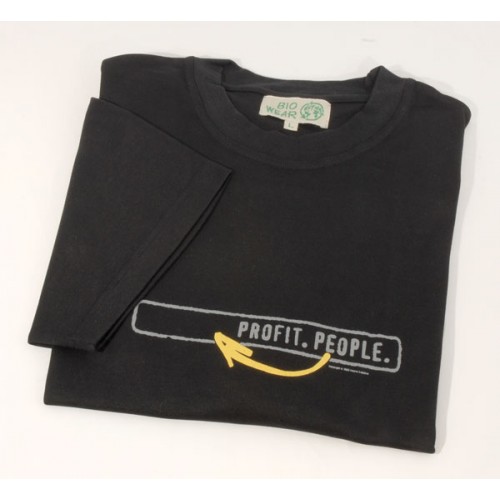
We can make a statement. So, when you go to the Games, wear a charity T-shirt. Doesn't matter which charity, just one you like. See if they stop you. If they do, go topless. If they don't let you do that, streak. Take pictures, take video, go viral.
Bring as much water to the venue as you dare. You're allowed 100ml. (It's absurd, I know. Never in my life did I think I would ever write the sentence: "You're allowed 100ml", referring to water. But that's corporate reality.) Have a condition. Insist you need your water for your medication. See if they challenge you. Faint if they do. And take an empty water bottle. The Olympic website on its list of prohibited and restricted items specifically allows this and says that venues have water fountains. Test this to the limit.
And wherever you go, ask for Rivella. Rivella is a family-owned business that has been making the most popular Swiss soft drink for decades. The Swiss are neutral and fiercely independent. Take a leaf out of their book and cock a snook at Coke. Nobody will stock it, so say that in that case you'll have a glass of tap water. If they don't serve you, retch, and then faint.
Share the love, be friendly, enjoy the Games, and take them back, these Games: they're yours.

(I have no connection with Rivella and I'm not related to the Barth family who own it. I just love it. But then I am Swiss. And they are an 'official partner' of the Swiss Olympic team. Which is nice of them and a little ironic, in a good way, I hope. You can get it in the UK from Genorel Soft Drinks. I'm not connected with them either and I don't get commission. The shirt in the picture above is from Amnesty International. I support Amnesty International. I also endorse Ben Cohen's Standup Foundation against bullying. You do whatever you know is right.)
sebastian's website sebastian on facebook
Thursday, 28 June 2012
the benign (one hopes) borg festival
Furthermore, I get the point of making it as 'inclusive' as possible, I can see the rationale of letting it happen all over the country, I understand the organisers' evident desire to appeal to everyone somehow, whilst trying hard to feature some paragons of well-respected excellence, and I applaud the undertaking of making some 10 million or so free tickets and 'opportunities' (by which, presumably, are meant general open admissions) available.
So far so good.
But is it just me, or has this Festival somehow managed to simply absorb, like a big - benign, one hopes, but in its encompassing reach still somewhat troubling - organism, everything it even vaguely comes in touch with. I'm not suggesting for one moment that any of the events listed in the official programmes tried to resist, but if, say, hypothetically, they had, would they even have been able to?
The Festival kicked off with appropriate fanfare in a place I'd never heard of called Bowness-on-Windermere, on Midsummer Night, 21st June, and a big concert with fireworks in Stirling. I imagine these, like many others until it officially closes with the end of the Paralympics on 9th September, were events specifically created for this series and they probably wouldn't have happened if it hadn't been for London 2012.
Less obvious, though, how the BBC Proms 2012 feature here. The Proms have been going for well over a hundred years and it is safe to assume that they would have happened again this year, Olympiad or no Olympiad. But at least they fall just about within the dates of the London 2012 Festival.
Not quite so with Lucian Freud Portraits, on all accounts a tremendous retrospective looking over 70 years of one of Britain's finest artists. This opened at the National Portrait Gallery on 9th February and closed again on 27th May, very nearly a whole month before the London 2012 Festival even started. Einstein on the Beach, the mesmerising Philip Glass masterpiece, directed by Rober Wilson: been and gone at the Barbican, in May. The inspired Globe to Globe season of Shakespeare interpretations from across the world: April and May.
Ongoing, regular, seasonal or year round: Poems on the Underground. The Serpentine Pavilion (this year another triumph, by Ai Weiwei and Herzog & de Meuron). Any number of performances at the Edinburgh International Festival, the National Theatre and the Swan in Stratford-upon-Avon.
Don't get me wrong: these are all wonderful initiatives, installations and events and I have no hesitation in endorsing them, praising them even! I just hope they all got a fair amount of money out of the Olympics because otherwise it would be hard to see why they should be so roundly appropriated by London 2012.
I imagine the idea is to just put everything that's happening culturally across the country this year under the banner of London 2012, to make sure we all appreciate that what we've got here is a good thing. Trouble with that is only that we know what we've got here is a good thing. Both the Olympics and everything that's happening culturally across the country. But while come 2013 the Olympics will be gone, the country will still be here, and so we better make sure there'll be some money then and into future years to keep these good things happening...
The London 2012 Festival website
sebastian's website sebastian on facebook
Tuesday, 12 August 2008
奥林匹克
i am in beijing.
sadly, not literally, although that had absolutely been an intention of mine, which then didn't quite work out for timing and practical reasons, but in spirit. i love the olympics. as a concept. as an idea. as an event. always have done. always, i imagine, will do. i love everything about it: the drama, the spectacle, the sheer magnitude of it all. i love the fact that it brings everybody together, in peaceful contest, and i love the way it makes heroes not only out of those who go swiftest, fly highest, and are strongest, but also of those who have the courage to hang on in there, come what may, for their own private victory. i love the fact that we celebrate an eric the eel or an eddie the eagle almost as much as a sir steve redgrave. i love the way the olympic movement calls itself a 'movement' and the way it's rooted in ancient greek civilisation, and i love it for giving cities and countries the opportunity to stage the greatest show on earth. so yes: i'm all for the olympics.
and say about china what you will: they know how to stage an olympics. that opening ceremony: well nigh perfect. and, now we learn, also a little fake. which is a pity, because it was impressive enough as it is; faking fireworks or substituting a pretty girl for a slightly less pretty one (is she really?) was hardly necessary. but in any case, how london is going to follow that is, at the moment, anyone's guess. for my money (which, to a very small proportion, it after all is) the thing to do, most likely, is to go in the opposite direction. obviously, what beijing put together in terms of precision, mass choreography, scale and discipline is not going to be matched here. we don't have the numbers, the money or, for want of a better word, the homogeneity in society to come up with that level of visual impact created by performers. i doubt we have the skill, even. and sarah brightman, well... in a way it's probably best she's done her bit now for the olympics. that should put the idea of using her again in the next twenty to thirty years right out of anybody's mind.
of course, the ceremony made a point, at some stage, of representing the 50-odd ethnic groups that make up today's peope's republic of china, but it is still fair to say that one of london's greatest strengths as a city is its genuinely global cultural and ethnic diversity. so london 2012 won't be the same as beijing. and nor should it be. beijing was well nigh perfect, for beijing. for london, a whole different approach will be right. one that plays to london and britain's strengths just in the way that the beijing ceremony played wholeheartedly to the strengths of china. and if that results in a smaller, quirkier, perhaps less bombastic but no less engaging show, that maybe even displays a sense of humour, then so much the better. but in terms of what we wanted from beijing in an opening ceremony, 08 08 08 has delivered. and then some.
settling down now in front of the TV (and - thank you, thank you BBC for the iplayer - at the computer) to absorb wall-to-wall coverage, i realise that here is one thing that has clean dropped off the 'things to do before i die' list: winning the 100m gold. on track or in the pool. in fact, winning any type of medal in any kind of sport for me is now so unlikely as to be considered impossible. and i'm not somebody who uses the word 'impossible' lightly. i really never say never. but the opportunity, i believe i can now concede, for me to represent my country (either of my two countries) at an olympic games (any olympic games, winter or summer) in any sport at all has now, with likelihood bordering on certainty, gone.
but before you start feeling sorry for me: this really is no great loss, seeing that i've never had the slightest ambition to be an athlete of any description, ever. i quit school sports in more or less mutual agreement with my PE teacher (it was more mutual attrition, but i won) by the age of about fifteen, and at the last school i went to for the last eighteen months of my secondary education i set foot in the sports centre precisely once: to tell the teacher there that i wouldn't be coming to any of his classes. (i had, to make this less of a suggestion and more of a non-negotiable statement of intent, brought along a certificate attesting to the dubious usability of my left knee, issued by a sympathetic GP even though the x-ray had shown up nothing of the sort...)
when i and my three best friends at school decided, at one stage, to take tennis lessons, it took us no more than about four weeks to find out that quite as much fun could be had by going for the ice cream not after the class, but during it, and the effort involved was substantially less exhausting.
so really: a sportsman was not lost in me. which makes my admiration for athletes all the greater. i really genuinely wish each and every one of them all the best. for me, just that fact that they've made it there, and are there now, in beijing, not as spectators, commentators or volunteers - all of whom we also couldn't do without, i know - but as participants, makes them little heroes in their own right. some of them become great big heroes, or are such already, and some may in the course of the next two weeks be toppled from their pedestal. but they are all olympians and that, to my mind, makes them great people, and i salute them from afar.
there's one though who i have a particular admiration for. consider this: some eleven thousand men and women compete in this year's olympic games. out of these, exactly ten are publicly, openly, known to be gay: nine women and one man. his name is matthew mitcham, and he's a twenty-year old australian diver. he is, in beijing 2008, the 'only' gay man competing.
now obviously, everybody's sexuality is their own business and i've never subscribed to the view that public figures should be 'outed'. but to think that in the year 2008 there are likely to be in the region of five hundred to a thousand sportsmen and women at world class level who, for reasons of their own, find it necessary or preferable not to come out in public, seems a touch retrograde. and it brings back that old question that was so much on people's minds during the era of 'gay liberation', right into the late eighties and early nineties, and that in almost any other field of excellence - the arts, music, even politics for the most of it, though it's questionable whether politics can be seriously counted as a field of excellence any more - has now been effectively answered: are there any positive role models? is it all right to be young, talented and gay? matthew mitcham says yes. and for that alone he commands my respect.
of course, i can't put his medal hopes above those of our own tom daley, for example; but in any event, in any discipline of any sport: may the best man win. or woman. or team. (or, as in the case of tom daley, youngster...)